The ranking from high to low
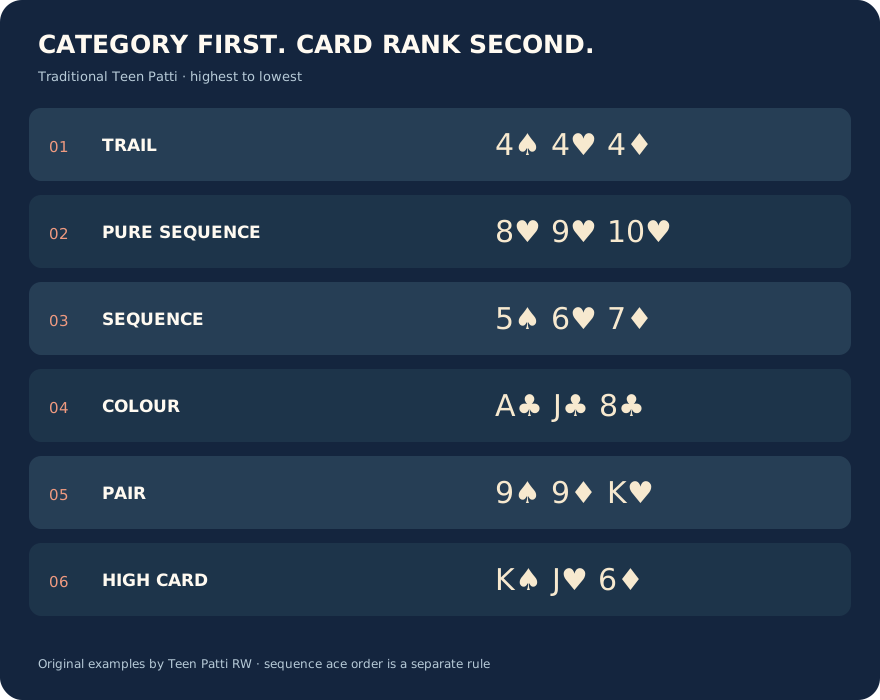
| Order | Category | Example | Recognition |
|---|---|---|---|
| 1 | Trail / trio | 4♠ 4♥ 4♦ | Three matching ranks |
| 2 | Pure sequence | 8♥ 9♥ 10♥ | Consecutive ranks, one suit |
| 3 | Sequence | 5♠ 6♥ 7♦ | Consecutive ranks, mixed suits |
| 4 | Colour / flush | A♣ J♣ 8♣ | One suit without a sequence |
| 5 | Pair | 9♠ 9♦ K♥ | Two matching ranks |
| 6 | High card | K♠ J♥ 6♦ | None of the above |
When the category matches
For pairs, compare the pair rank before the remaining card. In 8♠ 8♥ A♦ versus 9♣ 9♦ K♠, the pair of nines ranks higher even though the other hand has an ace.
For colour or high-card hands, compare the highest rank, then the next rank if needed, then the last. A♣ Q♣ 4♣ ranks above A♥ J♥ 8♥: the aces tie and the queen decides.
Use suits to recognise, not to guess
Suits tell you whether three consecutive ranks form a pure sequence or a normal sequence. Do not invent a suit tie-break when the chosen rules do not provide one. Two hands can have equal card ranks; how a mode resolves an overall tie is a separate rule.
Try the distinction
Choose a category, explain why it applies, then compare ranks. Practice category order and same-category tie-breaks or use the ace-rule reference for consecutive hands.